Key Takeaways
- Fleet maintenance is the scheduled and unscheduled servicing of a group of vehicles under one operator's control, tracked per unit rather than per driver.
- A preventive maintenance program saves an estimated 12 to 18 percent over a reactive one, according to the U.S. Department of Energy. The figure you see everywhere, that reactive costs three to five times more, does not appear in any DOE publication we could find.
- For a rental fleet the repair invoice is the smaller number. At an industry average of $1,379 in revenue per unit per month, every idle day costs roughly $45 in rate you cannot book, before the shop bill.
- FMCSA's maintenance rules under 49 CFR Part 396 do not apply to a standard passenger rental vehicle. Your 15-passenger vans and box trucks need to be checked separately.
- The maintenance decision that actually moves money is when a vehicle comes out of service, and only the reservation calendar can answer that.
What is fleet maintenance?
Fleet maintenance is the practice of servicing, repairing and inspecting a group of vehicles operated under one business, tracked per unit rather than per driver. It covers scheduled preventive work, unscheduled repairs, safety inspections and the records behind both. For a rental fleet it also governs availability, because a unit in the shop cannot be rented.
That last sentence is the whole reason this article exists. Every fleet maintenance guide on the first page of Google is written for a trucking company, a municipal fleet or a service business. Those operations put vehicles to work. You sell yours by the day. When a delivery van goes into the shop, the fleet absorbs a route. When one of your cars goes into the shop, a rate day disappears and never comes back.

Fleet maintenance vs. fleet management
The two terms get used interchangeably and they are not the same thing. Maintenance is a component of management, not a synonym for it.
For a rental operator the two collapse into one decision more often than they do anywhere else, which is the argument this piece builds toward.
How many vehicles make a fleet?
There is no universal number. Insurers, telematics vendors and software companies each draw the line where it suits them, commonly at five vehicles. Two thresholds do carry legal weight and are worth memorizing.
Thirty-five. Under the Raechel and Jacqueline Houck Safe Rental Car Act, a “rental company” is a business that uses a fleet averaging 35 or more covered rental vehicles over the calendar year (49 U.S.C. § 30102 (opens in a new tab)). Below that average, the federal recall grounding rules do not reach you.
10,001 pounds GVWR. That is where a vehicle becomes a commercial motor vehicle for FMCSA purposes, and where an entirely separate body of maintenance and inspection rules switches on. More on that below.
What are the types of fleet maintenance?
Four strategies, separated by what triggers the work.
Source: U.S. Department of Energy, Federal Energy Management Program and Pacific Northwest National Laboratory, Operations & Maintenance Best Practices Guide, Release 3.0 (opens in a new tab) (August 2010), Section 5.6, reproducing figures from Piotrowski (2001).
Read that column as a hierarchy, not as a price list for your Corollas. The figures are industrial equipment costs, measured per horsepower per year, published in 2010 from a source that was already a decade old. They tell you the order of the four strategies and roughly how far apart they sit. They do not tell you what an oil change costs. Anyone who quotes them at you as vehicle numbers has not opened the document.
Is predictive maintenance worth it for a small rental fleet?
The table above already separates predictive from preventive on the trigger: condition versus interval. The question the table cannot answer is whether you should buy it.
For most fleets under a few hundred vehicles, no, not as a separate program. Predictive maintenance earns its cost where a component is expensive and its failure strands a customer. Disciplined mileage-based preventive servicing, plus fault-code alerts from a telematics integration, captures most of the benefit without the overhead of a condition-monitoring program.
You already own two condition signals. Most operators underuse both.
The first is OBD-II fault codes, which arrive through a telematics integration the moment a vehicle throws a code, whether or not it is on rent. A check-engine light that surfaces on Tuesday while the car is out with a customer is a service appointment you can schedule for Thursday instead of a tow on Friday.
The second is the return inspection. You touch every vehicle every time it comes back. That is the highest-frequency condition signal any fleet operator has, and most operators throw it away because it lives on a clipboard. A structured digital inspection turns each check-in into a data point that can open a repair order.
Between those two you are collecting condition data. You are not paying a vendor to call it predictive maintenance. Spend the budget on the reliability of your preventive intervals first, then revisit predictive when the fleet is large enough that one failure mode repeats often enough to model.
Is preventive maintenance really cheaper than reactive?
Yes, but not by as much as you have been told. The claim that reactive maintenance costs three to five times more than preventive is not supported by the source it is credited to. The U.S. Department of Energy's published figures (opens in a new tab) show a 1.38x ratio between reactive and preventive, and estimate savings of 12 to 18 percent.

Where the “3-5x” number came from
Search “fleet maintenance cost” and you will find the same sentence on a dozen vendor blogs: reactive maintenance costs three to five times more than preventive, according to the U.S. Department of Energy. Several of those pages link to DOE. Follow the link.
DOE's O&M Best Practices Guide, Release 3.0 (opens in a new tab) (August 2010) says two things on this subject. Section 5.3 lists the advantages of preventive maintenance and gives an “estimated 12% to 18% cost savings over reactive maintenance program.” Section 5.6 compares four strategies at $18, $13, $9 and $6 per horsepower per year. Reactive against preventive is $18 against $13. That is 1.38 times, not three.
The only way to reach a 3x gap inside that table is to compare reactive against reliability-centered maintenance, the $18 against the $6. Reliability-centered maintenance is a different strategy with a different cost of entry, requiring failure-mode analysis and years of clean equipment history. Labelling that comparison “preventive vs. reactive” swaps one strategy for another under the same name, which is a larger problem than a rounding error.
We went and read the guide. The 3-5x claim is not in it, and we could not locate it in any other DOE publication. If you have been building a maintenance business case on that number, the number is wrong.
Why the real case for preventive is stronger than the fake one
The repair-cost comparison was never the whole picture for a rental fleet. A 12 to 18 percent saving on parts and labour is real money, and it is the smallest benefit preventive maintenance delivers to you. The larger one is control over timing.
Reactive means unplanned, and unplanned means the failure picks the moment. The moment it picks is the one where the vehicle is already on rent or booked for tomorrow morning, and that is where the money leaves.
What does a vehicle in the shop actually cost a rental operator?
A vehicle out of service carries two costs: the repair itself, and the rental revenue the unit cannot earn while it sits. At an industry average of $1,379 in revenue per unit per month, every idle day costs roughly $45 in unearned rate before a single line of the shop invoice is counted.
The arithmetic, shown
Auto Rental News (opens in a new tab) reported U.S. revenue per unit at $1,379 per month for 2025 in its 2026 Fact Book (December 2025), down from a revised $1,427 in 2024. Divide by an average month:
That $45 is our arithmetic, not a figure ARN published. It is an industry average across operators with very different rates, fleets and utilization, so run your own: take last year's revenue, divide by your average fleet size, divide by 365. The number you get is what one idle day costs you, and it is the number that belongs in every maintenance conversation you have this year.
Three days in the shop for a transmission service costs you the $600 invoice plus $135 of rate you could not sell, before you consider whether those three days landed in a week when you were turning customers away. Run your own version of this in the ROI calculator, or read where the rest of it goes in 9 Money Leaks Draining Car Rental Revenue.

Scheduled downtime is cheaper than the same repair unscheduled
Identical part, identical labour, different total.
The repair line is the only row where the two columns match. Every other row is a cost that exists because nobody chose the timing.
What maintenance costs per mile
Two benchmarks, both useful, neither a rental-car number on its own.
AAA, Your Driving Costs 2025 (opens in a new tab) (September 2025) puts maintenance, repair and tires at 11.04 cents per mile on a new vehicle, inside a total ownership cost of $11,577 per year at 15,000 miles. This is the closest published benchmark to a rental sedan, and it still assumes one owner-driver rather than forty renters.
ATRI, Analysis of the Operational Costs of Trucking: 2026 Update (opens in a new tab) (July 2026) puts repair and maintenance at about 22 cents per mile for 2025, up 8.6 percent year over year and up 45 percent since 2019.
ATRI's figure describes Class 8 trucks. Do not put it in a budget for a Nissan Versa. Use it for the trend, which is the point: maintenance costs have risen faster than almost any other line item across every category of fleet, and a maintenance budget built on 2019 assumptions is now short by close to half.
Do DOT and FMCSA maintenance rules apply to a rental fleet?
For standard passenger rental vehicles, no. FMCSA's maintenance rules under 49 CFR Part 396 apply to commercial motor vehicles, defined as vehicles in interstate commerce at or above 10,001 pounds GVWR (opens in a new tab), or carrying more than 8 passengers for compensation, or more than 15 passengers not for compensation. A rental sedan or SUV meets none of these.
This matters because the competing guides get it wrong. Search “fleet maintenance” and the top results open their compliance section with Part 396 and the systematic inspect-repair-maintain duty, as though it applied to everything with wheels. If you run 60 cars and two minivans, that section is describing somebody else's obligation, and following it costs you time you could spend on the rules that do bind you.
A note on citation, because it trips people up: § 390.5 has been suspended, and § 390.5T (opens in a new tab) carries the operative definitions. The text of the commercial motor vehicle definition is identical in both. Cite 390.5T if you are writing this into a policy document.

The two exceptions worth checking
1. Vehicles in your own fleet that do qualify. Fifteen-passenger vans, box trucks and cargo vans rated above 10,001 pounds GVWR are commercial motor vehicles. If you rent them in interstate commerce, Part 396 applies to those units and the records requirements come with it. Most mixed fleets have three or four of these sitting in a corner of the lot, maintained on the same schedule as the sedans.
2. Who the obligation attaches to. 49 CFR 396.3(a) (opens in a new tab) binds “every motor carrier and intermodal equipment provider” to systematically inspect, repair and maintain vehicles subject to its control. The duty follows the motor carrier operating the vehicle in interstate commerce, which is not automatically you as titleholder. A commercial customer renting your box truck for their own freight may carry that duty themselves. Get this settled in the rental agreement rather than after an inspection.
The rule that does bind you
The Safe Rental Car Act, at 49 U.S.C. § 30120(i) (opens in a new tab), covers rental companies using a fleet averaging 35 or more covered vehicles, defined as vehicles rated at 10,000 pounds GVWR or less and rented without a driver for an initial term under four months. When a recall notice lands, you must stop renting and stop selling the affected vehicles within 24 hours, extended to 48 hours if that notice covers more than 5,000 vehicles in your fleet.
NHTSA's October 2023 consent order with Zipcar (opens in a new tab), carrying a $300,000 civil penalty with half deferred, was the first enforcement action of its kind against a rental company. It established that the agency intends to enforce the grounding clock rather than treat it as guidance.
Recall handling in practice, including how to catch a notice before a customer does, is covered in our posts on digital vehicle inspection and fleet insurance. The contribution here is narrower: the FMCSA rules most maintenance guides hand you are not yours, and the one that is has a 24-hour clock on it.
What belongs on a rental fleet maintenance schedule?
Most maintenance schedules are copied from an OEM service book and run on a calendar. Both choices are wrong for a rental operation. Five things separate a rental schedule from a generic one.
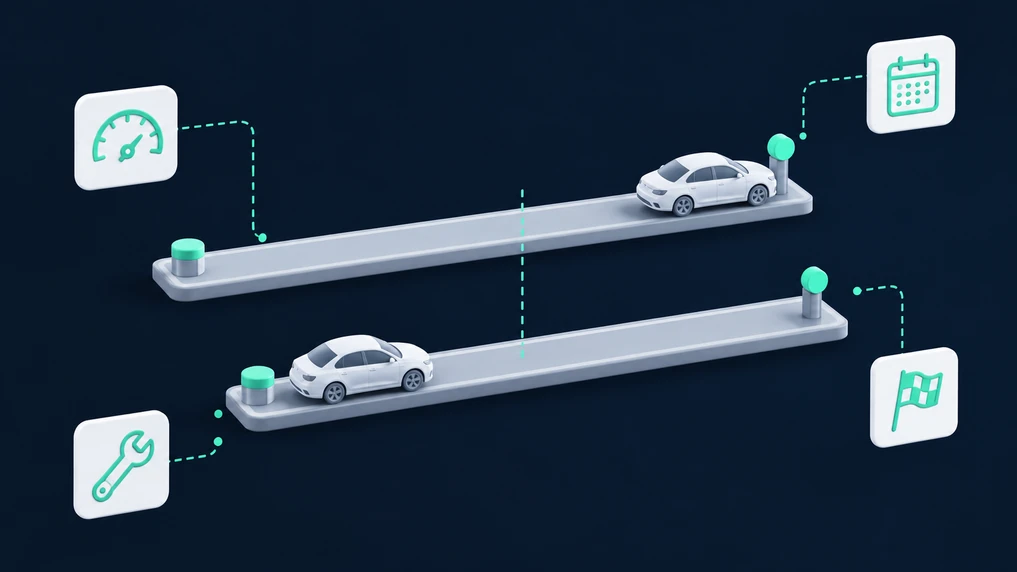
- Trigger on mileage, not on the calendar. Rental units accumulate miles unevenly and fast. A six-month interval under-serves the unit that did 14,000 miles on airport runs and over-serves the one that sat on a dealership loaner lot. Mileage thresholds fire when the vehicle has earned the service.
- Treat the return inspection as your real preventive trigger. You already touch every vehicle at every check-in. A tire that will not survive another cycle, a brake noise, a fluid weep: these show up at return, days before they show up as a failure. The operators who catch them are the ones running a structured inspection that can open a repair order on the spot.
- Schedule against demand, not against the calendar. A service window in a peak week costs the rate day at its highest value. The same window in a slow week costs the rate day at its lowest. Same repair, different price, and the only thing that changed was which day you picked.
- Decide wear versus damage while the record is fresh. A rental unit cycles through dozens of drivers. Whether a scuffed wheel is wear or a billable damage claim is a maintenance judgement with a revenue consequence attached, and it gets harder to make with every day that passes.
- Maintain for the de-fleet, not just for the rental. Service history follows the unit to auction. A documented maintenance record is worth real money in residual value, and an undocumented one is worth an argument.
What should be on a fleet maintenance checklist
The expected list, kept tight because it is table stakes rather than the reason you are here: engine oil and filter, tire tread depth, pressure and rotation, brake pads and rotors, all fluid levels including coolant, brake and transmission, battery health and terminals, exterior and interior lighting, wiper blades and washer fluid, belts and hoses, alignment and suspension, HVAC and cabin filter, and open recall status. Run it against mileage bands rather than a single master interval, and record the result against the vehicle record rather than a sheet in a binder.
When reactive maintenance is the right call
Nobody ranking for this topic will admit it, and every operator who has run a lot knows it: run-to-failure is the correct strategy for some parts.
Wiper blades, bulbs, cabin filters and a 12V battery near end of life are cheap, quick to swap, and their failure does not strand anyone or create a safety exposure. Inspecting them on a schedule costs more labour than replacing them when they go. Preventive maintenance is a budget, and you spend a budget where failure is expensive or where it leaves a customer on the shoulder of a highway. Spending it on wiper blades means not spending it on the brake job that would have prevented a tow.
The test is two questions. Does the failure of this part strand a customer or create a safety issue? Does failure cost more than scheduled replacement? A no to both means run it to failure and stop feeling bad about it.
How do you reduce fleet downtime?
Four levers, in the order they pay back.
- 1Fire service triggers from mileage, not from memory. A threshold that fires on its own catches the unit nobody was watching. Do this this week: pull your five highest-mileage units and check the date of their last service. The gap you find is the size of the problem.
- 2Block the unit in the reservation calendar the moment service is booked. A vehicle promised to a customer and to a technician on the same morning is a downtime event you created. Do this this week: name the one place a counter agent can see that a vehicle is going into service. If the answer is a person, that is the gap.
- 3Keep repair orders and service history on the vehicle record. History in a technician's inbox is history you cannot use at the next service, at the next damage dispute, or at auction. Do this this week: pick a unit at random and try to reconstruct its last three services in under two minutes.
- 4Watch recall status continuously, not at rental time. Discovering an open recall while a customer is at the counter is the expensive way to find out. Do this this week: run your current fleet VINs against NHTSA's recall database and see what comes back.
Idle-day economics for dealership loaner fleets, where the utilization math works differently, are covered at length in Loaner Fleet Management.
What does maintenance software need to do for a rental fleet?
Fleetio, UpKeep and MaintainX are well-built products for fleets that use vehicles. A rental fleet sells them by the day, which means the maintenance decision and the revenue decision are the same decision, and you can only make them together if maintenance and the reservation calendar live in one system. A maintenance tool bolted onto a rental platform gives you two screens and a person in the middle reconciling them. That person is where the double-booked vehicle comes from.
RentWorks Plus is built the other way around:

- Maintenance alerts and repair orders on the vehicle record, with service history that persists across rentals, across renters, and through to de-fleet.
- Vehicle status tied to availability, so a unit entering service disappears from the booking calendar on its own instead of being promised twice.
- Dashboard alerts and reporting that put overdue services and inspection risks next to fleet status and revenue, where somebody will see them.
- Inspections across 60+ mapped vehicle zones, turning every check-in into a condition signal that can open a repair order.
- Reservation Planner showing what a service window actually blocks, so preventive work lands on a slow Tuesday rather than a peak Friday.
In-house vs. outsourced maintenance
The honest answer is that it turns on volume and on what you are willing to manage.
Outsourcing to an independent shop or a fleet service network wins below roughly 100 units. You pay a higher per-job rate and you buy out of hiring technicians, stocking parts, carrying a bay and managing a schedule. The rate difference does not come close to the fixed cost of a shop you cannot keep busy.
In-house starts to win when you have enough volume to keep a technician working most of a week, and when turnaround time is the binding constraint rather than cost. The gain is control of the queue rather than a better labour rate: a unit needed for Friday goes in on Wednesday instead of whenever the shop can fit it.
Most operators between 50 and 200 units land on a hybrid: routine preventive work in-house or with one contracted mobile technician, everything mechanical outsourced. Whichever you choose, the service record has to come back into your system. An outsourced program with no data trail costs you the residual value at auction and the argument at the damage claim.
Frequently Asked Questions
What is predictive maintenance, and how is it different from preventive maintenance?
Preventive maintenance runs on a fixed trigger, a time or mileage interval, whether or not the part needs attention. Predictive maintenance runs on condition: telematics fault codes or wear data signal that a component is degrading. Preventive services the calendar. Predictive services the evidence. Below a few hundred units, preventive intervals plus fault-code alerts capture most of the predictive benefit.
What should a preventive maintenance schedule look like?
A generic PM schedule runs in mileage bands: an oil and filter service plus a visual inspection every 5,000 to 7,500 miles, tire rotation and brake check every 10,000 to 15,000, fluids and filters every 30,000, and belts, hoses and transmission service every 60,000 to 100,000. Anchor to the OEM interval, then tighten it for severe-duty use, which is what rental is.
What is a good maintenance cost per mile for a fleet?
For light passenger vehicles, 9 to 12 cents per mile for maintenance, repair and tires is a reasonable target band, with AAA's 2025 figure of 11.04 cents as the reference point for a new vehicle. Above 15 cents on a fleet under five years old suggests deferred maintenance, severe-duty conditions or a shop rate worth renegotiating.
Is vehicle maintenance tax deductible for a rental business?
Maintenance and repair costs on vehicles held for business use are ordinarily deductible as operating expenses, while work that improves a vehicle or extends its useful life is generally capitalized and depreciated instead. The line between a repair and an improvement is fact-specific and the treatment of rental fleet vehicles varies by structure and jurisdiction. Take this one to your accountant.
What records should I keep for fleet vehicle maintenance, and for how long?
Keep, per unit: VIN and identifying details, the schedule of inspections and services performed, repair orders and invoices, and inspection reports. FMCSA requires regulated carriers to hold these for the period of control plus six months. Non-regulated rental fleets have no federal minimum, so the practical standard is the life of the vehicle plus your state's limitation period for injury claims.
Is a spreadsheet good enough to track fleet maintenance?
Up to roughly 20 vehicles with one person maintaining it, yes. It breaks at the point where the spreadsheet and the reservation calendar disagree, because nothing forces them to match. The first double-booked service day, or the first recall you discover at the counter, is the signal you have outgrown it.
What KPIs should I track for fleet maintenance?
Five carry most of the weight: fleet availability rate (units rent-ready ÷ total fleet), mean time to repair, maintenance cost per unit and per mile, preventive-to-reactive work ratio measured by both count and spend, and PM compliance rate (services completed on schedule ÷ services due). Availability is the one to report upward, because it converts to revenue.
How many mechanics does a fleet need?
A common planning ratio for light-duty fleets is one technician per 50 to 75 vehicles, tightening to one per 30 to 40 for heavier-duty or high-mileage units. Rental fleets sit at the favourable end of that range because the work is mostly routine preventive servicing rather than diagnostic repair.
How much does fleet maintenance software cost?
Standalone fleet maintenance and CMMS products generally run $3 to $15 per vehicle per month, with entry tiers around $100 to $300 per month for a small fleet. A rental platform that includes maintenance is priced on the whole operation instead, which usually costs less than running two systems and reconciling them.
Who maintains rental cars, and how often are they serviced?
The rental company owns the maintenance obligation on its own fleet, using in-house technicians, contracted shops or dealer service departments. Most operators service on mileage rather than time, commonly every 5,000 to 7,500 miles, which for a well-utilized unit means every two to three months. Renters are not responsible for scheduled maintenance.
What does “fleet maintained” mean on a used vehicle listing?
It means the vehicle spent its service life in a commercial fleet and was maintained on a documented schedule rather than at an owner's discretion. Fleet units usually carry higher mileage and more cosmetic wear, and often better-documented mechanical history. For a rental operator selling at auction, that documentation is the part that shows up in the price.
What happens if a maintenance light comes on during a rental?
An oil-life or service-due indicator is informational and the rental can continue to the scheduled return. A check-engine, temperature or oil-pressure warning means the customer should stop and call. Set this out in the rental agreement and roadside instructions, decide in advance who authorizes an on-road repair, and flag the unit for service at check-in.
Who pays for maintenance on a rental vehicle, the renter or the company?
The rental company pays for scheduled maintenance and for mechanical failures the renter did not cause. The renter is responsible for damage, misuse and negligence as defined in the rental agreement, including wrong-fuel events and ignored warning lights. Whether a repair is wear or renter-caused damage is a judgement call, which is why documented condition at check-out and check-in settles most disputes.
The bottom line
The maintenance argument the rest of the industry makes to you is built on a statistic that does not survive a look at the source. The real argument is better, and it is one only a rental operator can act on: the choice in front of you is about who picks the day a vehicle comes off the line, you or the vehicle. Parts and labour follow from that.
At $45 a day in forgone rate, the difference between a service window you scheduled and a failure you did not is most of the margin on the job. Making that call needs the shop schedule and the reservation calendar in the same place, and everything downstream of it is bookkeeping.