Key Takeaways
- Most carriers cannot price an unknown driver, so they decline car rental fleets as a class. Rental risk is placed through specialty programs, wholesalers, or excess and surplus markets, and a declination usually says more about the agent than your operation.
- Roughly 10 to 12 states make your policy primary and 15 to 17 make it excess. In more than 20 states no statute settles it, so your own rental agreement decides who pays first.
- National commercial auto averages run about $110 a month for a sedan and $130 for an SUV, from $79 in Pennsylvania to $312 in Michigan. Your rental quote will land above all of those figures.
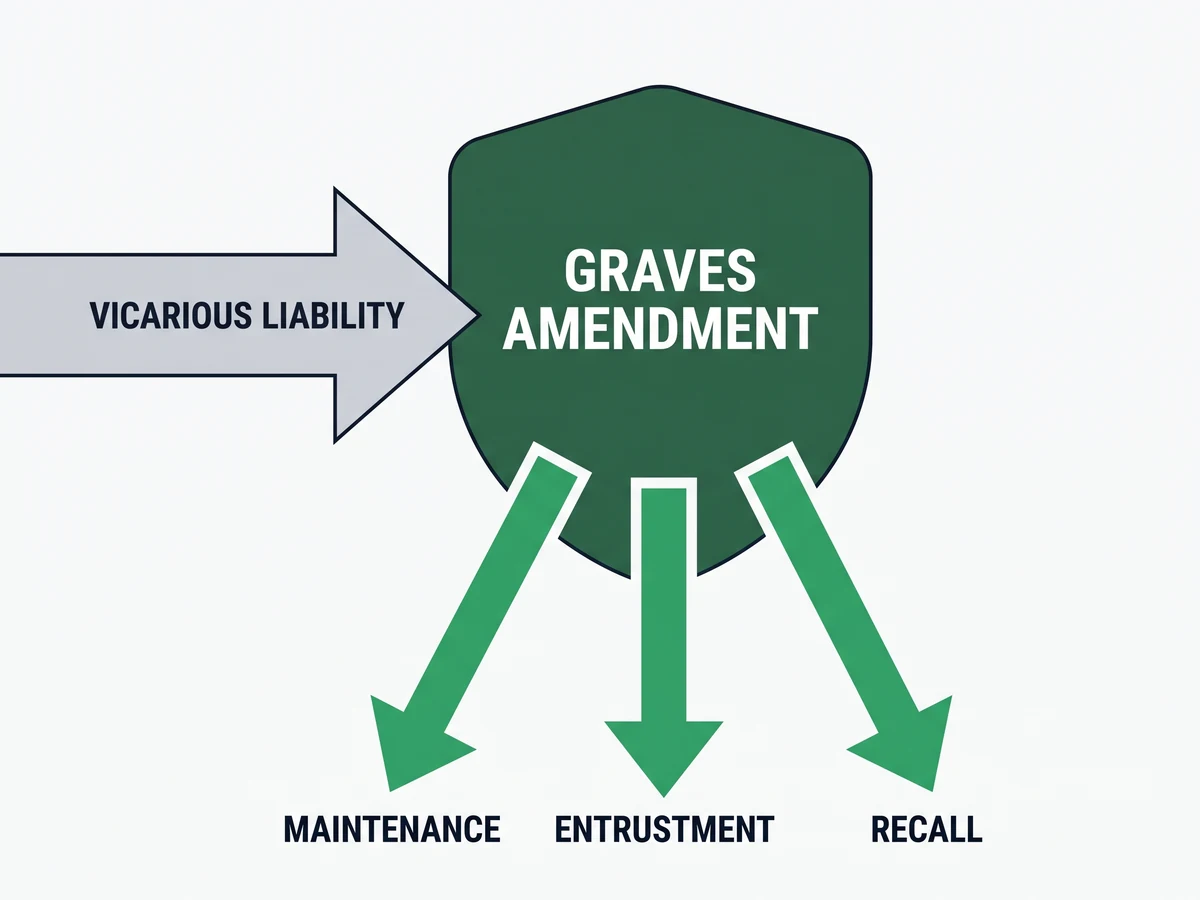
- The Graves Amendment shields you from a renter’s negligence, but only while you were not negligent yourself. Missing maintenance records, unverified licences, and open recalls each break that shield.
- A damage claim has four parts: repair costs, loss of use, administrative fees, and diminished value. Most operators bill the first and absorb the rest, and on the illustrative figures in Section 8 the absorbed amount outweighs what a rate negotiation returns.

Do you know whether your policy pays first?
Not the limits. The order.
A renter wrecks one of your cars, a third party sues, and one insurer responds before anyone else. Is it your car rental fleet insurance, or the renter’s own policy?
I ask operators this all the time. Four out of five cannot tell me.
That is not a knock on them. The answer sits in the endorsements, it changes by state, and nobody has ever made them read it. But it moves more money than any other line in your program.
This guide walks the same path you walk at renewal, in order. Getting quoted, qualifying, finding out who pays first, choosing coverage, pricing it, protecting it, and getting money back in.
It applies whether you run dealership loaners, an airport counter, a franchise, a corporate long-term fleet, or luxury and specialty units. Fleet size and vehicle values move the numbers. The order of the questions does not.
Use the table of contents to jump to your question, or read start to finish if you are approaching your first renewal.
Before We Start
We are not brokers. We do not sell insurance and we cannot quote your fleet.
We do sell rental management software, and Section 8 says where it fits. Sections 1 through 7 stand on their own.
What we have is an unusual seat. Bluebird has built the systems operators run their counters on since 1982, and it runs a claims recovery team, so we see the claim file at the moment someone tries to recover money, and which records survive an adjuster.
What’s in This Guide
Every section opens with a short answer in bold. Read the ten bold lines and you have the argument.
- 1Who Insures Car Rental Companies?
- 2How Many Vehicles Do You Need for Fleet Insurance?
- 3Is Your Policy Primary or Excess?
- 4What Insurance Does a Car Rental Business Need?
- 5How Much Does Car Rental Fleet Insurance Cost?
- 6Does Fleet Insurance Cover Any Driver?
- 7What Voids Your Fleet Insurance Coverage?
- 8What Can You Charge a Renter for Damage?
- 9What Is a Loss Damage Waiver, and Should You Sell It?
- 10How Do You Choose a Fleet Insurance Broker?
What is fleet insurance for a car rental business?
That last sentence explains the rest of this guide. One stranger after another, driving your assets.
It shapes what you pay, what you can claim, and who will even quote you.
1. Who Insures Car Rental Companies?
You called three agents. One never called back. One quoted something absurd. One said they would look into it.
Your renewal is 60 days out.
That happens to most operators, and the reason is mechanical. Standard commercial auto pricing assumes a known driver, meaning an employee you hired and pulled a motor vehicle record on. An underwriter can model that person. They cannot model a stranger who produced a licence at your counter twenty minutes ago, so many carriers decline the class rather than guess.
So the market that writes car rental fleet insurance is smaller. Four routes exist:
Do This This Week
A declination usually means you reached a carrier with no appetite for rental risk. It rarely means your operation is the problem.
Ask any agent one question before you send your loss runs: how many rental fleet programs do you place right now, and with which carriers?
A number tells you they write this class. A paragraph about their capabilities tells you they do not.
2. How Many Vehicles Do You Need for Fleet Insurance?
This is the question operators ask most, and it has a frustrating answer. There is no industry rule.
A fleet policy is a rating and administration structure, not a legal category, so carriers decide for themselves where it starts to make sense. In practice most will write one somewhere around two to five vehicles. Some specialty rental programs set their floor higher, and others will write a single unit and call it commercial auto.
Threshold ranges here are general market observation, not carrier rates. Ask the specific carriers your broker approaches.
Where Does the 35 Come From?
Operators trade the number 35 around as if it were an insurance threshold. It is not.
Under 49 U.S.C. § 30102(a)(11), a “rental company” is a business renting covered vehicles using a fleet averaging 35 or more of them over a calendar year.
That definition governs the federal recall grounding clock in Section 7. It says nothing about whether a carrier will quote you.
Two different thresholds, two different consequences. A 28-unit operator who thinks they are exempt from everything is exempt from one bright-line rule and exposed to ordinary negligence instead.
Is Fleet Insurance Cheaper Than Individual Policies?
Assume you can get either. Which should you want?
Look at row four, because it is the one nobody warns you about. A serious loss on a fleet policy can reprice every car you own at renewal, where separate policies would have contained it.
That is still usually the right trade. The administrative saving is real, the leverage is real, and most specialty rental programs prefer to write a fleet structure in the first place. But it raises the stakes on your loss run, which is the argument for everything in Sections 7 and 8.
Do You Need Fleet Insurance for Turo?
Peer-to-peer hosts sit in a gap between two things that look like coverage.
Your personal auto policy almost certainly excludes commercial use, and renting your car to a stranger generally falls inside that exclusion. So a claim during a rental period can be denied outright, and the policy can sometimes be cancelled for misrepresentation. Platform-provided protection is not a commercial fleet policy either. It responds during the rental period under its own terms and limits, so read what it does between rentals, during your own use, and above those limits.
Three signals say you have crossed into needing a real commercial policy:
- The income reads as a business on your tax return
- You move vehicles yourself between rentals, deliveries, or airport runs
- You hold vehicles worth more than the platform program’s limits
Whether that gap is worth crossing is a different question from whether you can cover it. Hosts who have run both models tend to describe the same trade.
Platform protection terms change. Confirm current terms with the platform and your own broker before relying on either.
Ask your broker where the fleet-size breakpoints sit in each program they can reach, and what improves when you cross one.
3. Is Your Rental Company’s Policy Primary or Excess?
This is the most valuable section in the guide, so let me be plain about the words first.
Primary means your policy responds before anyone else’s. Excess means the renter’s insurance goes first, and yours picks up what is left.
Who pays first decides what shows up in your loss run, and your loss run is the document a carrier reads at renewal long before anything you tell them about your operation.
Your Position May Not Be Written Down
The subrogation firm Matthiesen, Wickert & Lehrer keeps a chart covering all 50 states and DC. (Subrogation means an insurer chasing a third party to recover what it paid out.) It sorts into three groups.
Read that third group again, because it is the largest of the three.
In more than twenty states no legislature has answered this question, so your rental agreement answers it. The biggest single driver of your loss ratio may be sitting in a contract your own business wrote and has not revisited in years. Unlike a statute, you can change that document this month.
Even a Written Rule Can Move
The states in the first group can shift, which is the part operators rarely price in.
New York is the clearest recent example. Its Vehicle and Traffic Law § 370 had long been read to make rental companies provide primary coverage, so your policy paid first up to the state minimum whatever the renter carried.
In Second Child v Edge Auto, Inc., the New York Court of Appeals split that rule in two. The duty to carry minimum insurance survived, protected by the Graves Amendment savings clause at 49 U.S.C. § 30106(b). The requirement that your coverage be primary did not.
The reasoning was not specific to New York. Any state law that makes rental coverage primary, rather than asking only that coverage exist, faces the same argument.
So there are two questions. Where does your state sit today, and is that position statutory, contractual, or currently being litigated?
Source: Second Child v Edge Auto, Inc., 2026 NY Slip Op 02436, decided April 23, 2026. Full citations in Sources.
What the Difference Costs You
A renter with their own auto policy causes $40,000 of damage to a third party. Same crash, two structures.
Twelve of those in a year puts $300,000 of paid losses on your account instead of zero. At renewal that is the gap between a rate discussion and a non-renewal letter.
Minimum Limits and Licensing
Two more things vary by state, and both survived the Graves Amendment.
Minimum limits. The savings clause at § 30106(b) protects state insurance standards. Even where courts have struck down a primary coverage mandate, the duty to carry minimum limits has not come into question. Car rental business insurance requirements start here, and you cannot negotiate them.
Rental licensing. Separate from insurance and from a general business licence. Several states treat vehicle rental as its own regulated activity:
- California. A Vehicle Lessor-Retailer licence from the DMV, plus rental car agent licensing from the Department of Insurance if your staff sell the products in Section 9
- Nevada. Short-term lessor licensing through the Nevada DMV
- Hawaii, Virginia and South Carolina. Each adds its own rental or lessor registration
Do This This Week
Operate across state lines and every question above becomes per-state, answered by two different offices.
Send your broker this sentence:
Then open your own rental agreement and find the paragraph about whose insurance responds first. In a state with no statute, that paragraph is the answer.
Then list every state one of your cars entered in the last 12 months and confirm two things for each: your licensing status and your minimum limits. Most operators find a state they had never considered.
4. What Insurance Does a Car Rental Business Need?
Most explainers on this topic describe a company car driven by an employee. That is not your risk, so the definitions below use your counter instead.
The Four You Need
Everyone talks about commercial auto liability. Physical damage decides whether you make money, which is why Section 8 comes back to it.
The Ones You Have to Ask For
Count how many of those exist because strangers drive your cars. That pattern runs through the whole topic.
Pull your declaration pages and tick off what you carry. A gap in loss of use, garagekeepers, or umbrella outranks your rate as an agenda item.
5. How Much Does Car Rental Fleet Insurance Cost?
No article can quote your fleet. Benchmarks give you a floor, and a way to judge whether the number in front of you is defensible.
How much is insurance for a car rental business?
Current benchmarks, verified August 20, 2026
By state, the range runs from $79 a month in Pennsylvania to $312 in Michigan. Local regulation, medical costs, and how often cases go to court all feed that spread.
On renewals, average commercial auto rates moved up 5.24 percent, with umbrella the steepest commercial line at 8.27 percent. Those figures draw on more than 120 million transactions across 38,000 agencies. According to the Ivans Index, April 2026.
Look at the state spread once more. Where you garage your cars moves your rate more than which cars you buy.
Your own quote will sit above every figure in that table, and Section 1 explains why. Those averages come from a market built to price known drivers, and the carriers who write your class know they are pricing something else. Treat a quote near the benchmark with suspicion rather than relief.
Monthly Cost by Fleet Size
The Premium-Drivers Checklist
Use the table above to sanity-check a quote you already hold.
Every line below is something a carrier prices, and something you can change before the quote gets written.
- Loss run quality. Three to five years, with closed claims closed on paper
- Minimum renter age and licence checks, written down and followed
- Maintenance intervals with service records per vehicle
- Open recall procedure, and how fast you can prove you grounded a car
- Photo condition records at handover and return
- Telematics or GPS across the fleet
- Garaging location down to the ZIP code
- Vehicle mix and values, with luxury units flagged separately
- CDW and LDW take rate, and how the carrier treats that revenue
No email required. Print it and bring it.
Two lines on that checklist decide more claims than the rest of it. Start with who you hand the keys to.
6. Does Fleet Insurance Cover Any Driver?
A fleet policy answers the same question somewhere in the endorsements. Who is permitted behind the wheel?
For a company fleet, that is a list of employees. For you it is a definition, and the definition has edges.
Who Counts as an Authorised Driver?
Minimum renter age. Most rental programs set one, commonly at 21 or 25, sometimes with a young-driver surcharge above it. Rent below your policy’s minimum and you find out at claim time which kind of term you broke.
Additional and unauthorised drivers. A renter’s spouse takes over at a rest stop. Nobody added them to the agreement. Whether they are covered turns on your policy wording and on what your counter recorded.
Personal and employee use. Your own staff moving cars between locations, running an airport shuttle, or taking a unit home. Those are your employees driving your vehicles, which most policies rate separately from a rental, and it is why employee driving records sit on the checklist in Section 5.
Why This Is Not a Detail
Insurers price your age rules and then hold you to them. A written minimum age you follow is something a carrier can rate on. A written minimum age your counter overrides on a slow Tuesday is a coverage argument waiting for its crash, and the gap between them is a control at the point of booking, not a memo.
Age ranges and driver categories here are general market observation, not policy terms. Only your own policy wording and your carrier can tell you which of these is an exclusion, a condition, or a rating factor.
Find the driver definition in your policy and write down your minimum age, what happens either side of it, and who counts as an authorised additional driver. Then check whether your counter can rent outside that definition. If it can, that is the gap.
7. What Voids Your Fleet Insurance Coverage?
49 U.S.C. § 30106(a) protects vehicle owners in the rental business from liability for what a renter does, on one condition. No negligence or criminal wrongdoing by you, the owner.
Plaintiffs’ lawyers treat that condition as a checklist. So do claims adjusters.
Poor Maintenance Records
A renter crashes and the brakes were worn.
You did the service. The record is a note in a drawer, or it does not exist.
The shield turns on whether you were negligent. Without a maintenance file, the other side’s expert answers that question while holding your brake pads. The service you performed and the service you can prove are two different assets, and only one has value after a crash.
A defensible record has three parts: the schedule that said the service was due, the work order showing it happened, and both attached to that specific vehicle rather than to a month.
Unverified Licences
You rented to someone unlicensed, visibly impaired, or whose licence nobody checked.
“Nobody checked” is where operators lose. A licence glanced at and handed back leaves no trace. A licence scanned and attached to the agreement leaves a timestamped record.
A lawyer will ask how you confirmed that driver held a valid licence that day. One of those two answers ends the questioning.
Open Recalls
This one runs on a clock set by federal law.
Grounding a car inside 24 hours means knowing which units are affected and being able to change unit status across every location at once.
Now look at that threshold again, because Section 2 flagged the trap.
Run 28 loaners and you sit below the definition, so the 24-hour federal clock does not bind you. That is worse, not better. Your exposure runs through ordinary negligence instead, which means a jury decides what a reasonable operator should have done, with no bright line to point at.
Worn brakes, an unchecked licence, an ungrounded recall. Each one is a paperwork failure before it becomes a legal one, and an operator who did the work but cannot prove it lands close to the one who skipped it.
Do This This Week
Pick three vehicles at random. For each, produce the last service record, the licence scan from its most recent rental, and today’s recall status.
If any of those nine documents takes more than two minutes to find, you have found your renewal project.
Those three protect the money going out. Section 8 is about the money coming back in.
8. What Can You Charge a Renter for Damage?
Your premium is one negotiation a year. Damage happens on every return.
That is why this section matters more than Section 5.
The Claim Most Operators Never File
When a renter damages a car, what did it cost you?
Most operators answer with the repair bill. That is half of it. The other half is every day the car sat in a body shop instead of earning on your lot. That is loss of use, and you can claim it.
Insurers push back by arguing you lost nothing, because you had other cars available, then ask for turndown reports to prove your fleet was not full.
That argument lost in court.
In Koenig v. PurCo Fleet Services, Inc., 2012 CO 56, the Colorado Supreme Court held that a business can measure loss of use either by lost profits or by the reasonable rental value of a replacement vehicle, and the claimant picks. Losing the use of commercial property is itself a harm, separate from lost profit. In plain terms: that car was not worthless to you because you owned others.
Two things decided the case, and both are in your control.
Your contract wording. PurCo’s agreement said damages were owed regardless of fleet utilization, and the court leaned on that phrase. A silent agreement leaves the utilization argument open.
The daily rate on the signed agreement. It proves what that car was worth to rent that week, because it is a real price someone paid.
So loss of use and physical damage rest on the same paperwork. Two claims, one set of documents.
The Four Things You Can Recover
Most operators bill the repair and stop there. A damage claim has four separate components.
Look down the right-hand column. Not one of those four turns on how bad the damage was.
All four turn on what you can produce. Bill only the repair and you have collected a fraction of the claim.
Two Operators, One Dent
A returned sedan has a $900 dent in the rear quarter panel. The renter says it was already there.
Operator B lost twice. He absorbed the repair, and he never got as far as the second claim.
Look at the last row too. His loss never reaches a loss run, so no underwriter ever sees it. It surfaces in the P&L, which is why it stays invisible for years.
Now weigh that against the other lever.
At roughly $226 of monthly contribution per vehicle, one unrecovered $900 claim wipes out about four months of that car’s profit.
Twenty of those a year is $18,000 that no rate negotiation recovers. It belongs on the same list as the other money leaks that never show up as a line item.
What Your System Has to Do
We build this software, so read the next part as disclosure rather than a recommendation.
Every failure in this guide is a missing document.
Worn brakes with no service file. A licence nobody scanned. A dent with no photograph from handover. A car off the road for eight days that nobody billed for.
RentWorks Plus is organised around those documents:
Two of those rows do double duty. Telematics sits on the premium-drivers checklist in Section 5 and it is broker question 6, so the same module that tracks a car may also earn you a credit. Reporting gives you the attachment rate Section 9 says underwriters ask about.
One caution about automated inspection, because it cuts against an easy assumption. Photo damage detection speeds up the counter and makes the report consistent. It does not win the claim.
The claim turns on holding a timestamped record at handover and at return, so the two can be set side by side. A faster inspection at one end only is worth no more than the paper form.
Sources: RentWorks Plus platform, Self Inspection and Bluebird integration (Auto Rental News, April 2025), Bluebird Recovery Services.
Do This This Week
Pull your last five damage claims. Two counts, not one.
How many held photographs at both handover and return? That is your evidence rate.
And on how many did you bill loss of use, administrative fees, or diminished value rather than the repair alone? That is your recovery rate.
9. What Is a Loss Damage Waiver, and Should You Sell It?
Operators underrate the second effect. A strong CDW attachment rate tells an underwriter you handle a real share of your physical damage exposure by contract, before it becomes a claim, so bring that number to your renewal. If you do not know it, start measuring.
One caution. Several states, California most clearly, regulate who may sell these products at a counter and license the staff who do it.
10. How Do You Choose a Fleet Insurance Broker?
I will not rank car rental business insurance companies for you. Appetites shift, programs close to new business, and a carrier that suited a 40-unit dealership fleet in January may not write it by September, so a ranked list goes stale in a quarter. What I can tell you is who writes fleet insurance for car rental companies, so you know what to ask for.
Who Writes Rental Fleet Risk?
How to Spot the Right Broker
Watch for seven signals:
- They ask your CDW and LDW take rate before they ask your fleet count. A general agent does not know what LDW is.
- They state your primary or excess position by state without looking it up twice.
- They ask how you document vehicle condition, unprompted.
- They raise loss of use as money to recover, not a box to tick.
- They hold more than one carrier with real appetite for rental risk, and they will name them.
- They raise open recall exposure before you do.
- They treat your loss run as something to improve, not something to submit.
Eight Questions for Your Renewal
That last one separates the two kinds of broker. One forwards your loss run. The other tells you which two claims are costing you most.
Ungated. No form, no download. The best insurance for a car rental business is the program whose answers you can live with.
- 1Is our policy primary or excess in every state we operate in? In writing, state by state. Ask which positions come from statute and which come from our own rental agreement.
- 2How do you treat damage we recover from renters? Does recovered money reduce our loss ratio, or does the claim count either way?
- 3Do we carry loss of use, and what do you need to pay it? Ask whether they contest it on fleet utilization.
- 4How is CDW or LDW structured here? A waiver we administer or an insurance product, and how do you treat the revenue?
- 5What do you need to pay a physical damage claim, and how fast do you pay it? Get the documentation list and compare it to what our counter produces today. Then get days from notice to payment on your actual book.
- 6Are there credits for telematics, GPS, or photo inspection systems? What qualifies, and what is the credit worth?
- 7Where are the fleet-size breakpoints, and what are the driver age rules? If we go from 40 cars to 55, does anything improve? Is renting below the age minimum an exclusion or a rating factor?
- 8How do you treat open recall exposure, and what triggers non-renewal? Ask whether coverage is conditioned on grounding recalled cars, then make them name the loss ratio, claim count, or single loss that ends the relationship.
Email questions 1, 5 and 8 before the meeting. How long a broker takes on question 5 tells you most of what you need to know.
Frequently Asked Questions
What is fleet insurance for a car rental company?
Fleet insurance for a car rental company, also called car rental fleet insurance, is one commercial policy covering every vehicle you own. It combines auto liability, physical damage, general liability, and garage liability. Rental fleets price above standard commercial auto rates because a different unvetted driver takes the wheel every few days.
How many vehicles do you need for fleet insurance?
No universal minimum exists. Most commercial carriers will write a fleet policy from around two to five vehicles, and each carrier sets its own threshold. The 35-vehicle figure operators often quote comes from 49 U.S.C. § 30102(a)(11), which defines a rental company for federal recall purposes, and has nothing to do with insurance eligibility.
Is fleet insurance cheaper than individual policies?
Often, though the reliable saving is administrative rather than a lower premium. One policy blends rating across the fleet and replaces per-vehicle underwriting with a single renewal and loss run. The trade-off is consolidation, because a serious loss can reprice every car. Most specialty rental programs prefer a fleet structure anyway.
How much does car rental business insurance cost?
National commercial auto benchmarks run about $110 a month for a sedan, $130 for an SUV, and $189 for a van, from $79 in Pennsylvania to $312 in Michigan (MoneyGeek, verified August 2026). Expect a rental fleet quote above all of those, because an unvetted driver carries more risk than an assigned company car.
What insurance does a car rental business need?
Four layers do the core work: commercial auto liability, physical damage on owned vehicles, general liability, and garage liability or garagekeepers. Beyond those, ask about loss of use, liability to renters, hired and non-owned auto, and cyber. Add workers' compensation once you employ anyone, plus an umbrella layer.
Why is it so hard to get a quote for a car rental fleet?
Most commercial carriers have no way to price an unvetted driver, so they decline the class rather than guess. Rental fleets are usually placed through specialty programs, wholesalers, or excess and surplus markets. A declination normally reflects a carrier with no appetite for the class, not a problem with your operation.
Does fleet insurance cover any driver?
Only the drivers your policy defines, and the definition has edges. Most rental programs set a minimum renter age, commonly 21 or 25. Additional drivers, unauthorised drivers, and your own staff moving vehicles are each handled differently. Ask your carrier which of those is a coverage question and which is a rate question.
Do I need fleet insurance to host on Turo?
Your personal auto policy almost certainly excludes commercial use, and renting to a stranger generally falls inside that exclusion, so a claim during a rental can be denied. Platform protection responds during the rental under its own terms and limits, which is not a commercial fleet policy. Confirm current terms with both.
Is my rental company's policy primary or excess?
Only your policy wording and your state's law can answer that. Roughly 10 to 12 states make the rental company primary and 15 to 17 make it excess, but in more than 20 no statute settles it, so the rental agreement decides. Positions also change: in Second Child v. Edge Auto, New York's Court of Appeals held the Graves Amendment preempts the state primary coverage requirement.
What is the Graves Amendment and does it cover my fleet?
The Graves Amendment, 49 U.S.C. § 30106, protects vehicle owners in the rental or leasing business from liability for a renter's negligence, on condition that the owner was not negligent and committed no crime. Its savings clause at § 30106(b) preserves state financial responsibility and insurance standards, so minimum limit requirements still apply to you.
Can I claim loss of use when a renter damages one of my cars?
Often yes, though the law varies by state. In Koenig v. PurCo Fleet Services (2012 CO 56), the Colorado Supreme Court held a business can measure loss of use by either lost profits or the reasonable rental value of a replacement vehicle, with the claimant choosing, so you need not prove fleet utilization. Two things decide whether you collect: your rental agreement's wording, and the daily rate on the signed contract.
Can my insurer deny a claim if a rented vehicle had an open recall?
Renting a car with an open recall creates real exposure, and a carrier's response depends on your policy conditions. Under 49 U.S.C. § 30120(i), a rental company must stop renting an affected vehicle within 24 hours of notice, or 48 hours where the recall covers more than 5,000 vehicles in its fleet. A rental company means one averaging 35 or more covered rental vehicles per calendar year.
What can I recover when a renter damages one of my cars?
A damage claim has four components: repair costs, loss of use for the days the car could not earn, administrative fees, and diminished value where your state allows it. Most operators bill the repair and stop. All four turn on the same evidence: condition records at handover and return, the signed daily rate, and a fee schedule agreed up front.
How do I choose a car rental insurance company?
Judge the broker before the carrier. One who writes rental fleet programs asks about your CDW and LDW take rate and your condition records without prompting, states your primary or excess position by state, raises loss of use as money to recover, and holds more than one carrier with real appetite for rental risk.
Does a vehicle inspection system lower my insurance costs?
Not reliably, and I will not promise it. Some carriers offer credits for telematics or documented inspection processes, but no standard discount exists that we can substantiate. What inspection records reliably improve is recovery, the share of renter-caused damage and loss of use you collect instead of absorbing. Ask your carrier what qualifies.
Conclusion
Carrier appetite, benchmark rates, state minimums, federal preemption. Your premium gets negotiated once a year by people working from documents you hand over, and you influence almost none of the inputs.
The documents are the exception. The maintenance file, the licence scan, the photos at both ends of a rental, the daily rate on a signed agreement, the utilization clause in your own contract. All of it runs every day, and all of it is yours.
Start with the two that pay fastest. Find out whether you are primary or excess in every state you operate in, and start photographing every car at handover and return.
The operators who recover damage are not luckier or better insured than you. They decided on some ordinary Tuesday to write things down properly.
You can start that on Monday.

The Bluebird Team
The team at Bluebird Auto Rental Systems, the company behind RentWorks Plus