Skip to main content
RentWorks Plus Bluebird Auto Rental Systems Book a Demo
AI Inspection add-on

The rental is tracked. The condition evidence should be too.

Manual walkarounds and disconnected photos make pickup and return hard to compare. AI Inspection adds a guided walkaround at both handoffs, pairs the photos, and flags possible changes, so your team reviews evidence instead of two recollections.

Powered by Self Inspection
Photo comparison Possible-change flag Staff decision
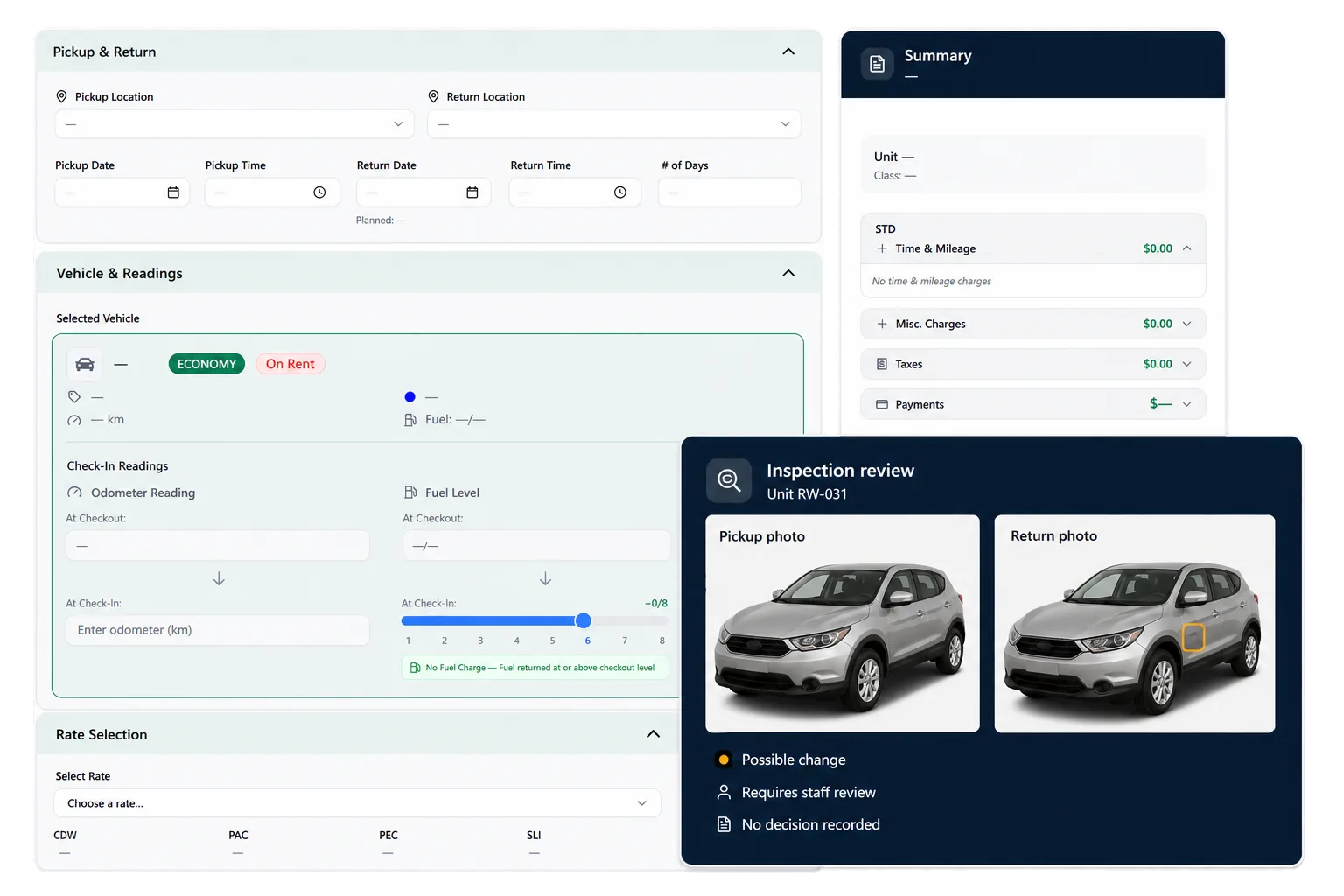
Pickup and return photos with possible condition changes flagged for staff review inside the RentWorks Plus inspection workflow.
What the add-on brings

AI trained on more than 20 million vehicle images.

Self Inspection reports over a million inspections completed, and more than 300,000 hours and $80 million in costs saved for its customers. Car rental is one of its named verticals, alongside dealerships, lenders, and fleets, and its rental use case is squarely about faster turnarounds and clearer condition records.

Confirmed damage can be converted into a repair-cost estimate using regional parts and labor data, so the number in front of the renter is grounded in something.

Guided capture on any phone

The app directs each shot, so a new hire and a fifteen-year veteran produce the same set of photos. Renters can complete a guided inspection too.

AI-assisted damage findings

Models trained on more than 20 million images detect and classify damage, with expert validation behind the automated result.

Condition reports that hold up

Images, timestamps, findings, notes, and a repair-cost estimate built from regional parts and labor data, packaged into one review-ready record.

Self Inspection reported impact
20–30%* More damage recovered
<1 min* Condition report generated
Pickup + return The same guided standard
Branch + client Both handoff types supported

* Self Inspection-reported figures. Results vary by workflow, configuration, and package.

How it works

One condition workflow, pickup to return.

Branch-based and client-led handoffs run the same three steps, inside the inspection your team already runs. AI narrows the review; staff make every damage and claim call.

1Inspection photos
RentWorks Plus inspection screen for a 2024 Volkswagen Tiguan, with captured left side and rear bumper photo angles listed beside the vehicle record.

Capture required pickup and return angles inside the same inspection screen.

2Photo comparison
Pickup and return photos of the same rear door side by side, with the return photo flagging a scratch at 94% AI confidence and a $480 estimated repair.

Possible condition changes are marked so the eye lands on them first.

3Staff review
A rental employee at a desk reviewing an AI inspection record and damage estimate on a desktop screen.

Authorized staff decide what the agreement covers and record the next step.

1

Capture

At pickup and again at return, an employee or the renter follows the same guided flow, so the standard does not change with who is holding the phone.

2

Compare

Supported photos are paired side by side. Possible condition changes are marked so the eye lands on them first.

3

Confirm and act

Staff decide whether the change is new and what the agreement covers, then move confirmed items into estimates and a review-ready condition record.

One workflow, clear roles

Who does what.

The two systems are not doing the same job. RentWorks Plus runs the rental. Self Inspection structures the condition evidence around each handoff.

RentWorks Plus

The rental record

  • Reservation, agreement, and return
  • Vehicle history across every prior rental
  • Claim context and damage recovery
Self Inspection

The condition record

  • Guided capture at pickup and return
  • Supported before-and-after photo comparison
  • Findings and repair-cost estimates
A person completing a guided walkaround of a blue compact SUV on their own phone, with the Self Inspection capture prompt on screen.

Branch-led handoffs

An employee runs the walkaround at the counter or on the lot. Useful where the vehicle never leaves staff hands and the queue is the constraint.

Client-led handoffs

The renter completes the same guided flow on their own phone. Useful for remote pickups, delivery, after-hours returns, and taking a step off the counter.

Inspection review card for unit RW-031: pickup photo on the left, return photo on the right with a Possible change label highlighted in amber; footer notes Requires staff review and No decision recorded.
Evidence stays with the rental

Before-and-after evidence, in one place.

Supported inspection records stay connected to the rental and vehicle history. Staff review the photos beside the agreement, return information, prior condition, and claim context, so the record supports the decision, not the other way around.

  • Pickup and return photos pinned to the unit and agreement
  • Possible-change markers preserved for the claim record
  • Staff decisions and notes stored beside the evidence
What you get

What actually changes on Monday morning.

Damage questions start from timestamped photos rather than two recollections.

Damage that used to get absorbed is documented well enough to pursue.

Turnaround speeds up because the walkaround is guided rather than remembered.

Client-led handoffs run the same standard as the branch, which takes a step off the counter.

Guardrails

People stay responsible for damage and claim decisions.

The analysis gives staff a place to focus. It does not decide whether a change is new, whether the agreement applies, or whether a claim or charge is appropriate.

A flag is not a decision

An AI flag does not establish fault, assign liability, or authorize any payment activity.

Staff own the call

Authorized staff weigh the evidence, agreement, policy, customer context, and claim information before acting.

Renters keep a path to review

The renter should have a clear way to review the record and question a decision your team records.

Scope

Define the image and data rules up front.

Your configured setup identifies image requirements, staff roles, access, consent, retention, analysis output, false-positive handling, geography, support, and claim handoff. The provider name and package terms belong in the scoped proposal.

Image requirements
Staff roles and access
Consent and retention
Analysis output
False-positive handling
Geography and support
FAQ

Frequently asked questions

Who provides the AI inspection technology?+

Self Inspection, a third-party provider, as an optional add-on to the native RentWorks Plus inspection workflow. The provider and the exact packaging are confirmed in your proposal.

Does AI Inspection decide who caused damage or what to charge?+

No. It can flag possible photo changes. Authorized staff review the evidence, agreement, policy, customer context, and claim information, and make every damage, liability, claim, and charge decision.

Can a renter be charged from an AI flag alone?+

No. Staff decide whether the evidence and agreement support a claim or charge, and provide the customer with the appropriate review path.

Can renters do the inspection themselves?+

Yes. Client-led handoffs let the renter complete the same guided flow on their own phone, which is useful for remote pickups, delivery, after-hours returns, and taking a step out of a busy counter queue.

Is AI Inspection included with RentWorks Plus?+

No. It is an optional add-on with its own cost, quoted separately from the platform.

What about dirty vehicles, rain, or bad lighting?+

Guided capture is designed to reduce that variability by directing each shot, but no photo-based system is immune to conditions. Ask us to walk through your worst case, an evening return in the rain, before you commit.

Book a 30-minute workflow review

Bring one recent pickup and return case. We map capture, staff roles, photo comparison, customer review, data handling, and claim handoff to your operation.

Book a Demo Explore Inspections and Claims
AI Inspection add-on

The rental is tracked. The condition evidence should be too.

Manual walkarounds and disconnected photos make pickup and return hard to compare. AI Inspection adds a guided walkaround at both handoffs, pairs the photos, and flags possible changes, so your team reviews evidence instead of two recollections.

Powered by Self Inspection
Photo comparison Possible-change flag Staff decision
Pickup and return photos with possible condition changes flagged for staff review inside the RentWorks Plus inspection workflow.
What the add-on brings

AI trained on more than 20 million vehicle images.

Self Inspection reports over a million inspections completed, and more than 300,000 hours and $80 million in costs saved for its customers. Car rental is one of its named verticals, alongside dealerships, lenders, and fleets, and its rental use case is squarely about faster turnarounds and clearer condition records.

Confirmed damage can be converted into a repair-cost estimate using regional parts and labor data, so the number in front of the renter is grounded in something.

Guided capture on any phone

The app directs each shot, so a new hire and a fifteen-year veteran produce the same set of photos. Renters can complete a guided inspection too.

AI-assisted damage findings

Models trained on more than 20 million images detect and classify damage, with expert validation behind the automated result.

Condition reports that hold up

Images, timestamps, findings, notes, and a repair-cost estimate built from regional parts and labor data, packaged into one review-ready record.

Self Inspection reported impact
20–30%* More damage recovered
<1 min* Condition report generated
Pickup + return The same guided standard
Branch + client Both handoff types supported

* Self Inspection-reported figures. Results vary by workflow, configuration, and package.

How it works

One condition workflow, pickup to return.

Branch-based and client-led handoffs run the same three steps, inside the inspection your team already runs. AI narrows the review; staff make every damage and claim call.

1Inspection photos
RentWorks Plus inspection screen for a 2024 Volkswagen Tiguan, with captured left side and rear bumper photo angles listed beside the vehicle record.

Capture required pickup and return angles inside the same inspection screen.

2Photo comparison
Pickup and return photos of the same rear door side by side, with the return photo flagging a scratch at 94% AI confidence and a $480 estimated repair.

Possible condition changes are marked so the eye lands on them first.

3Staff review
A rental employee at a desk reviewing an AI inspection record and damage estimate on a desktop screen.

Authorized staff decide what the agreement covers and record the next step.

1

Capture

At pickup and again at return, an employee or the renter follows the same guided flow, so the standard does not change with who is holding the phone.

2

Compare

Supported photos are paired side by side. Possible condition changes are marked so the eye lands on them first.

3

Confirm and act

Staff decide whether the change is new and what the agreement covers, then move confirmed items into estimates and a review-ready condition record.

One workflow, clear roles

Who does what.

The two systems are not doing the same job. RentWorks Plus runs the rental. Self Inspection structures the condition evidence around each handoff.

RentWorks Plus

The rental record

  • Reservation, agreement, and return
  • Vehicle history across every prior rental
  • Claim context and damage recovery
Self Inspection

The condition record

  • Guided capture at pickup and return
  • Supported before-and-after photo comparison
  • Findings and repair-cost estimates
A person completing a guided walkaround of a blue compact SUV on their own phone, with the Self Inspection capture prompt on screen.

Branch-led handoffs

An employee runs the walkaround at the counter or on the lot. Useful where the vehicle never leaves staff hands and the queue is the constraint.

Client-led handoffs

The renter completes the same guided flow on their own phone. Useful for remote pickups, delivery, after-hours returns, and taking a step off the counter.
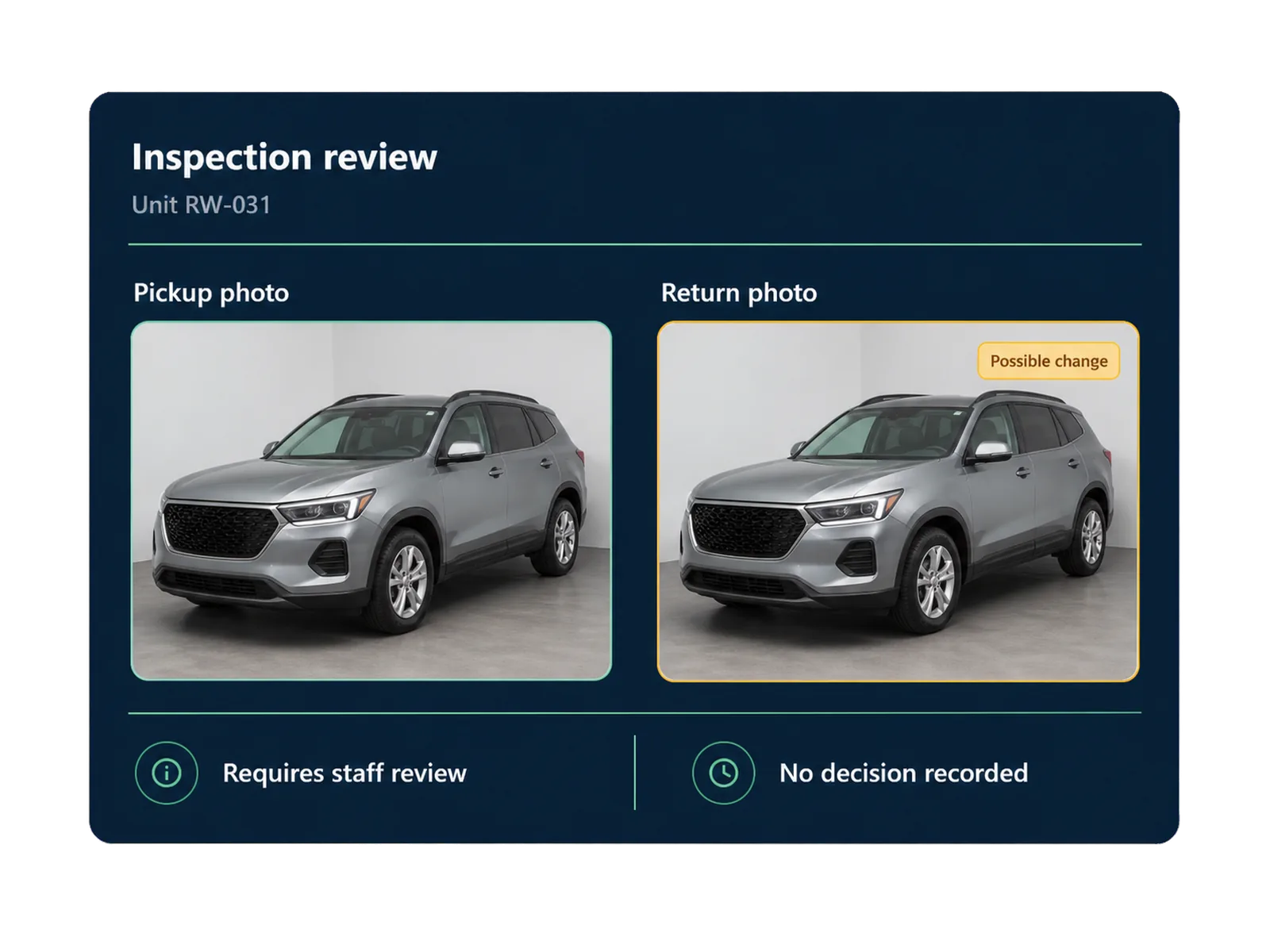
Inspection review card for unit RW-031: pickup photo on the left, return photo on the right with a Possible change label highlighted in amber; footer notes Requires staff review and No decision recorded.
Evidence stays with the rental

Before-and-after evidence, in one place.

Supported inspection records stay connected to the rental and vehicle history. Staff review the photos beside the agreement, return information, prior condition, and claim context, so the record supports the decision, not the other way around.

  • Pickup and return photos pinned to the unit and agreement
  • Possible-change markers preserved for the claim record
  • Staff decisions and notes stored beside the evidence
What you get

What actually changes on Monday morning.

Damage questions start from timestamped photos rather than two recollections.

Damage that used to get absorbed is documented well enough to pursue.

Turnaround speeds up because the walkaround is guided rather than remembered.

Client-led handoffs run the same standard as the branch, which takes a step off the counter.

Guardrails

People stay responsible for damage and claim decisions.

The analysis gives staff a place to focus. It does not decide whether a change is new, whether the agreement applies, or whether a claim or charge is appropriate.

A flag is not a decision

An AI flag does not establish fault, assign liability, or authorize any payment activity.

Staff own the call

Authorized staff weigh the evidence, agreement, policy, customer context, and claim information before acting.

Renters keep a path to review

The renter should have a clear way to review the record and question a decision your team records.

Scope

Define the image and data rules up front.

Your configured setup identifies image requirements, staff roles, access, consent, retention, analysis output, false-positive handling, geography, support, and claim handoff. The provider name and package terms belong in the scoped proposal.

Image requirements
Staff roles and access
Consent and retention
Analysis output
False-positive handling
Geography and support
FAQ

Frequently asked questions

Who provides the AI inspection technology?+

Self Inspection, a third-party provider, as an optional add-on to the native RentWorks Plus inspection workflow. The provider and the exact packaging are confirmed in your proposal.

Does AI Inspection decide who caused damage or what to charge?+

No. It can flag possible photo changes. Authorized staff review the evidence, agreement, policy, customer context, and claim information, and make every damage, liability, claim, and charge decision.

Can a renter be charged from an AI flag alone?+

No. Staff decide whether the evidence and agreement support a claim or charge, and provide the customer with the appropriate review path.

Can renters do the inspection themselves?+

Yes. Client-led handoffs let the renter complete the same guided flow on their own phone, which is useful for remote pickups, delivery, after-hours returns, and taking a step out of a busy counter queue.

Is AI Inspection included with RentWorks Plus?+

No. It is an optional add-on with its own cost, quoted separately from the platform.

What about dirty vehicles, rain, or bad lighting?+

Guided capture is designed to reduce that variability by directing each shot, but no photo-based system is immune to conditions. Ask us to walk through your worst case, an evening return in the rain, before you commit.

Keep exploring

Related to AI Inspection

Book a 30-minute workflow review

Bring one recent pickup and return case. We map capture, staff roles, photo comparison, customer review, data handling, and claim handoff to your operation.

Book a Demo Explore Inspections and Claims