It's 4:40 on a Friday. Three customers are lined up at your counter, a fourth just walked in, and the phone in the back has rung twice. Your agent is still typing the first customer's license number into the system.
You know the counter is slow. You probably don't know how slow, or which step eats the time.
Renters notice the wait. In J.D. Power's 2026 North America Rental Car Satisfaction Study, released October 7, 2026, ease of rental ranked first among the seven factors that shape how renters score a rental company. For most independent operators, the counter decides that score.
Let's find where your minutes go.
Key Takeaways
- Ease of rental is the top driver of renter satisfaction in J.D. Power's 2026 study, and independents win or lose it at the counter.
- A counter rental runs through seven steps. Time each one at your own location before you change anything.
- The quickest wins remove typing and paper: license scanning, card-on-file payments, auto-calculated quotes, e-signatures and photo inspections.
- Shaving minutes lets the same team handle a Friday rush without adding a shift.
How long does it take to rent a car?
It depends on your counter, and most operators have never timed theirs. A pickup runs through seven steps, from finding the reservation to handing over the keys. Steps that rely on typing or paper add the most minutes. Time five rentals at your own location and you'll have a number you can act on.
For most independent operators, the counter is the rental. Renters walk up, hand over a license, sign and take keys from a person. That makes every minute you remove from it worth more.
Where the minutes go: the 7 steps of a counter rental
Every counter rental follows roughly the same path, whether you run 15 cars or 500. Each step has its own way of leaking time.
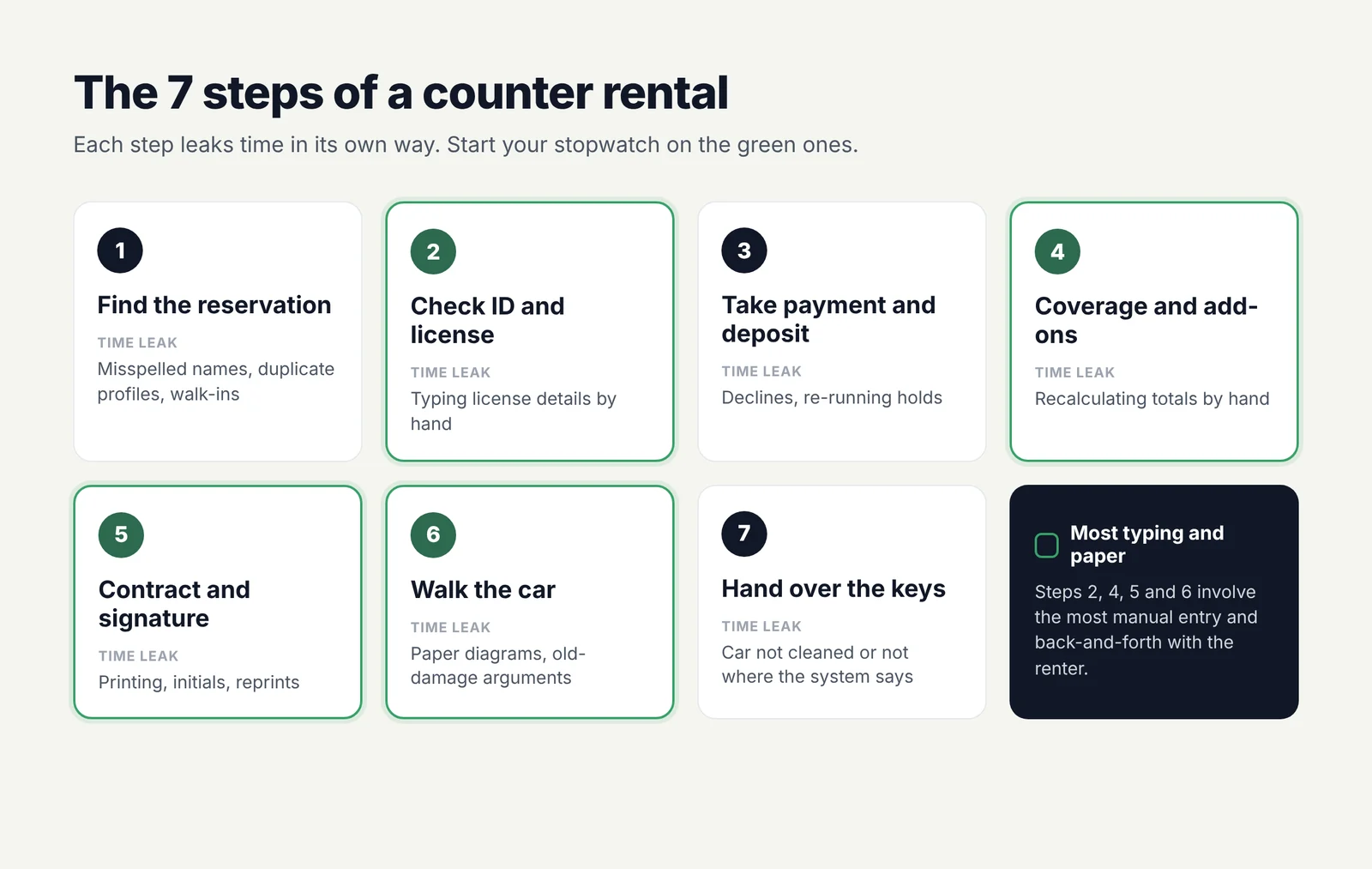
Steps 2, 4, 5 and 6 involve the most typing, paper and back-and-forth. Start your stopwatch there.
Time your own counter this week
You can get a real number in one shift. Pick five rentals across a normal day, including at least one during your rush. Stand where you can see the counter, use your phone's stopwatch, and write down the split each time the agent moves to the next step.
Time your counter
Use the stopwatch at the counter, or type in the splits from your phone. Averages and your two slowest steps update as you go.
- 1. Find the reservation –
- 2. Check ID and license –
- 3. Take payment and deposit –
- 4. Coverage and add-ons –
- 5. Contract and signature –
- 6. Vehicle walkaround –
- 7. Key handoff –
- Total––
Two tips keep the numbers honest. Tell your agents what you're doing and why, so they work at their usual pace. And time a walk-in alongside the reservations, since walk-ins skip nothing and show your worst case.
Once you have averages, circle the two biggest. That's where you start.
What a slow counter costs you
Slow counters cost you in three places: staff hours, customer scores and add-on revenue.
Staff hours. Take a location that handles 40 pickups on a Friday. At 20 minutes each, that's 800 minutes of agent time, more than 13 hours. Cut 5 minutes per rental and you get back more than 3 hours in a single day. (Plug in your own volume and your own stopwatch average.)
Customer scores. J.D. Power's 2026 study found satisfaction drops 111 points on its 1,000-point scale when the renter's reserved vehicle class isn't available. A car that isn't ready at handoff costs you more than minutes. Those renters write your Google reviews.
Add-on revenue. When the line is six deep, does your agent still walk through coverage and upgrades, or skip them to keep things moving? A skipped pitch lowers that rental's total.
In September 2026, Auto Rental News reported operators reviewing counter transaction times and staffing per rental as costs climb. One operator described the margin between making and losing money as "extremely thin."
How to cut counter time without cutting staff
The goal is more rentals per agent-hour at the busiest times of day. Operators in the Auto Rental News piece put it the same way: more productive staff, with headcount staying put.
Start with the free fixes. Three changes cost nothing:
- Collect license and card details when the booking comes in, so the counter confirms information instead of capturing it.
- Check tomorrow's arrivals the night before and stage those cars clean, fueled and parked where the system says.
- Trim your rental agreement to the pages a renter needs to sign.
Then take the typing out of each step. Here's how RentWorks Plus handles the slow steps from the table above.
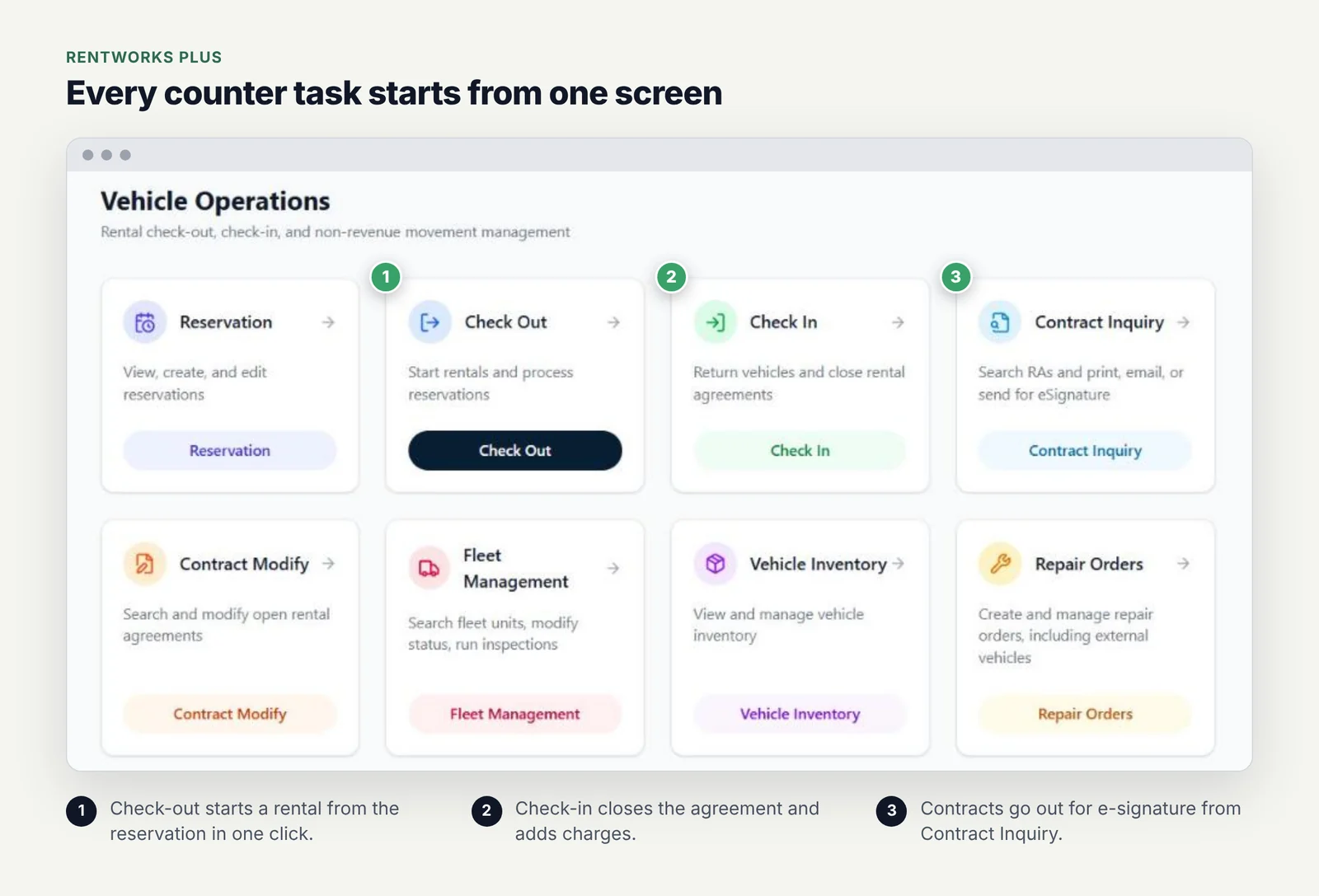
New hires matter here too. Built-in step-by-step guides inside RentWorks Plus help a new agent run a full check-out without someone standing over their shoulder.
Returns take counter time too
The return is the second half of every rental, and it often lands during the same Friday rush. Your agent checks fuel, records mileage, looks for new damage and settles the final bill while the next pickup waits in line.
The damage check drags, because the agent has to compare the car against whatever was noted at pickup. With RentWorks Plus, check-in puts the pickup photos beside the return photos, records the mileage and adds the charges to the bill. Your agent closes out the return and calls the next renter forward.
For a deeper look at why photo evidence settles damage disputes, read our guide to digital vehicle inspection for rental fleets.
Frequently Asked Questions
How long does it take to rent a car at the counter?
It varies by location, staffing and how much of the process still runs on paper. Typing in license details, quoting coverage, printing contracts and walking the car with a clipboard add the most time. Time five of your own rentals to get your real average.
What slows down a car rental counter the most?
Manual work. Typing license details, recalculating quotes, printing and initialing contracts and drawing damage on paper diagrams all add minutes. A car that isn't cleaned or staged when the renter arrives adds more.
How can a small rental company speed up check-out without self-service kiosks?
Collect license and card details at booking, stage tomorrow's cars the night before, and remove typing from the counter. License scanning, card-on-file payments, auto-calculated quotes, e-signatures and photo inspections each take time out of a different step.
Are electronically signed rental agreements legally valid?
In the United States, the federal ESIGN Act and state laws based on the Uniform Electronic Transactions Act generally give e-signatures the same weight as ink for most contracts. Canadian provinces have similar electronic commerce laws. Rules and exceptions vary, so confirm your agreement with your lawyer.
What matters most to rental car customers?
Ease of rental ranks first among the seven factors in J.D. Power's 2026 study, ahead of pickup and drop-off, trust and the vehicle. Having the reserved class ready matters too: satisfaction falls 111 points when it isn't available.
Conclusion
Your counter could run 12 minutes or 35, and you won't know until you time it.
So pick five rentals this week, fill in the worksheet, and circle your two slowest steps. If they involve typing, paper or a damage argument, you can win those minutes back without hiring anyone.
How long did your last Friday rental take?
Watch the 2-minute product tour to see a full RentWorks Plus check-out, or book a demo and bring your stopwatch numbers.
Related reading: 9 money leaks draining car rental revenue